
Semantica
Semantica is an MIT-licensed context and knowledge graph layer for AI agents, with deterministic reasoning, decision provenance, and self-hosted storage choices.
Quick verdict: Semantica is an open-source context and knowledge graph layer for AI systems that need more than similarity search. It records decisions, preserves provenance, applies deterministic rules, and can connect the resulting graph to agents through Python, a CLI, REST, or MCP. This is serious infrastructure rather than a one-click chatbot, but it is unusually broad if your real question is not just “what did the model retrieve?” but also “why did the system decide this, and where did the evidence come from?”
What is Semantica?
Semantica sits underneath an LLM, agent framework, vector store, or enterprise data platform. It ingests material from files, web pages, databases, APIs, streams, Git repositories, email, Databricks, and Snowflake; then it can parse, normalize, split, extract, deduplicate, and organize that material as a knowledge graph. The project positions this as graph-native infrastructure for accountable AI, not as a replacement for your model or agent runtime.
The useful distinction is that entities, relationships, facts, decisions, and sources become queryable objects. A vector database can find similar passages, while Semantica can also trace causal links, inspect earlier decisions, detect conflicting facts, enforce graph constraints, and export an audit trail. The current formal release is v0.6.5, published on August 11, 2026. The main branch already contains unreleased changes, so pin a release or commit when repeatability matters.
Main features
- Context graphs and agent memory: store facts, conversations, decisions, and relationships in a structure that supports graph traversal as well as semantic retrieval.
- Decision intelligence: record an outcome, reasoning, confidence, evidence, causes, and downstream effects, then search for precedents or trace a decision chain later.
- Provenance and governance: attach W3C PROV-O lineage to facts, validate graphs with SHACL, manage OWL and SKOS ontologies, flag conflicts, and export audit data as JSON, CSV, RDF, or related formats.
- Deterministic reasoning: run forward chaining, a Rete rule network, Datalog, and SPARQL so an inference path can be inspected instead of hidden inside a model response.
- Full knowledge pipeline: ingest many source types, extract entities and relations, preserve conflicting claims, merge duplicates, build graphs, create embeddings, and export the result.
- Swappable storage: use in-process options for experiments or connect RDF, property-graph, and vector backends such as Oxigraph, Neo4j, FalkorDB, Apache AGE, Neptune, Qdrant, Pinecone, pgvector, and others.
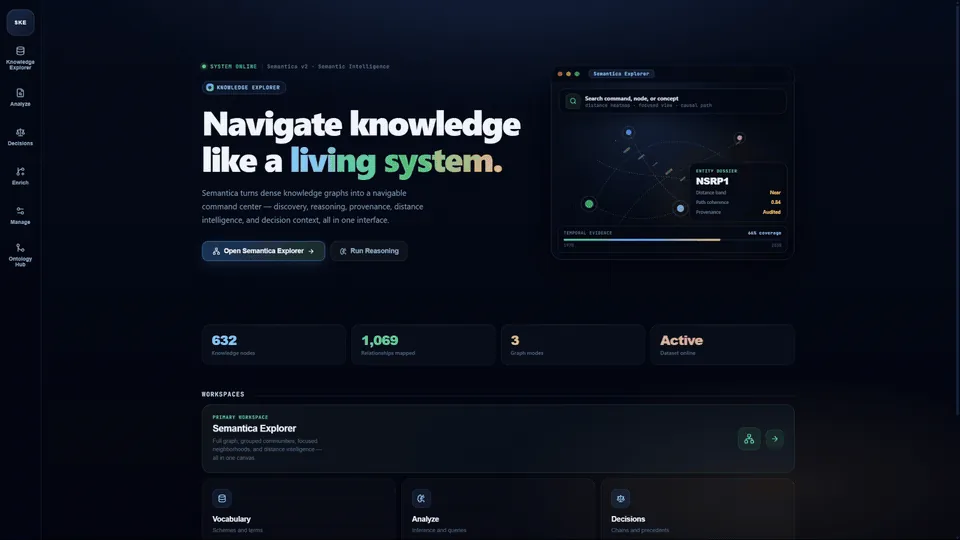
- Multiple integration surfaces: work through Python modules, a CLI, an interactive Knowledge Explorer, REST endpoints, an MCP server, or the native Agno integration.
Product characteristics and trade-offs
Semantica’s strongest characteristic is that its core graph, reasoning, and provenance workflows do not require an LLM. The default extraction path on the current main branch is being moved toward local ML and pattern-based methods, while provider-backed extraction remains opt-in. That separation is valuable when an audit trail must remain deterministic or when sensitive data should not be sent to a model API.
The other side of that flexibility is weight. The base Python package includes a substantial scientific and ML dependency stack, and production deployments add storage, authentication, monitoring, backups, and upgrade work. Optional integrations have their own services, credentials, and costs. The repository is moving quickly and the changelog openly documents fixes for incomplete or inconsistent paths, so this deserves a focused proof of concept before it becomes part of a regulated workflow. Treat the project’s compliance features as engineering building blocks, not as automatic legal or regulatory certification.
How to install and get started
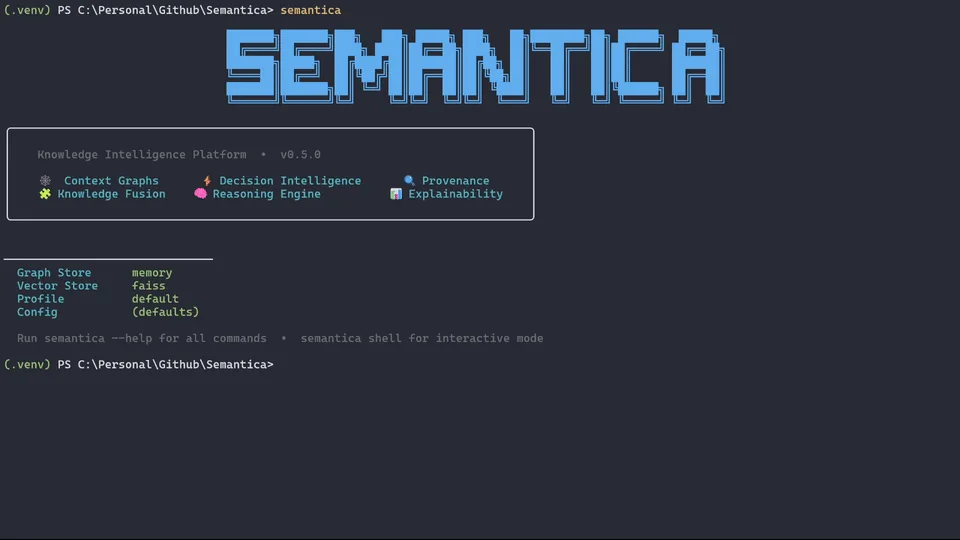
The official package supports Python 3.8 and newer. Start in a fresh virtual environment, install the core package, and run the built-in health check. The project’s own quick start is short:
python -m venv .venv
# Activate .venv with the command for your operating system
pip install semantica
semantica doctor
Next, record one local decision before connecting any external database or model. This verifies the most distinctive part of the product without creating a large deployment:
from semantica.context import ContextGraph

graph = ContextGraph(advanced_analytics=True)
decision_id = graph.record_decision(
    category="vendor_selection",
    scenario="Choose storage for an internal AI assistant",
    reasoning="Local control and an auditable migration path matter most",
    outcome="shortlist_self_hosted",
    confidence=0.86,
)

print(graph.trace_decision_chain(decision_id))
Install extras only for the path you actually need—for example, semantica[explorer] for the dashboard or a named graph/vector backend extra for persistent storage. For production, the README recommends Docker or Kubernetes, a strong SEMANTICA_SECRET_KEY, and persistent graph and vector stores rather than the smallest local defaults. Keep the service private until authentication, network binding, backups, and data retention have been reviewed.
Best use cases
Semantica makes the most sense when relationships and accountability matter as much as retrieval. Examples include an underwriting assistant that must preserve evidence behind a recommendation, a healthcare or legal research system that needs source lineage, a multi-agent platform sharing structured context, or a data team turning lakehouse tables into an explorable knowledge graph. It is also relevant for GraphRAG projects that have outgrown a flat vector index and need rules, time-aware facts, conflict handling, or graph analytics.
It is a weaker fit for someone who only needs a hosted chat-with-PDF page, a tiny embedded search component, or a managed service with contractual support. In those cases, the breadth of Semantica can become operational overhead. A good evaluation uses one decision-heavy workflow, a small representative dataset, and explicit checks for retrieval quality, trace completeness, latency, storage growth, and the behavior of conflicting facts.
Pricing and license
The repository and Python package are released under the MIT License, so the core software is free to use, modify, and redistribute under that license’s conditions. Semantica itself does not remove the cost of infrastructure: graph databases, vector stores, cloud data platforms, model APIs, compute, storage, observability, and engineering time may all be separate expenses. Review the licenses and commercial terms of every optional backend, hosted provider, model, and dataset you connect.
Practical evaluation
Semantica is one of the more ambitious open-source attempts to make AI context explainable rather than merely searchable. The combination of decision records, provenance, ontology controls, deterministic reasoning, GraphRAG, and interchangeable storage is genuinely useful for teams that would otherwise assemble those layers themselves. The official Explorer also gives stakeholders a clearer view of what is inside the graph than a collection of backend APIs alone.
The sensible way to adopt it is incrementally: pin v0.6.5, prove one local workflow, add one persistent backend, and only then introduce model-based extraction or enterprise connectors. Watch the unreleased changelog and test your chosen modules during upgrades, because the repository’s rapid pace cuts both ways. If your system needs defensible decisions and source-level traceability, Semantica is worth that evaluation. If you only need straightforward semantic search, a narrower RAG or vector tool will probably be easier to operate.