
Agent Governance Toolkit
Agent Governance Toolkit is Microsoft's open-source governance stack for enforcing policies, identity, sandboxing, auditing, and reliability controls around autonomous AI agents.
Quick verdict: Agent Governance Toolkit is for the moment when an AI agent stops being a demo and starts touching real systems. Microsoft’s open-source project adds deterministic policy checks, identity, audit records, sandboxing, and reliability controls around agents built with popular frameworks.
The practical idea is simple: telling a model “never delete production data” is not a security boundary. A governance layer should inspect the requested action before the tool runs, then allow, deny, or route it for approval. That makes this toolkit relevant to teams deploying agents with access to databases, email, browsers, code execution, or other consequential tools.
What is Agent Governance Toolkit?
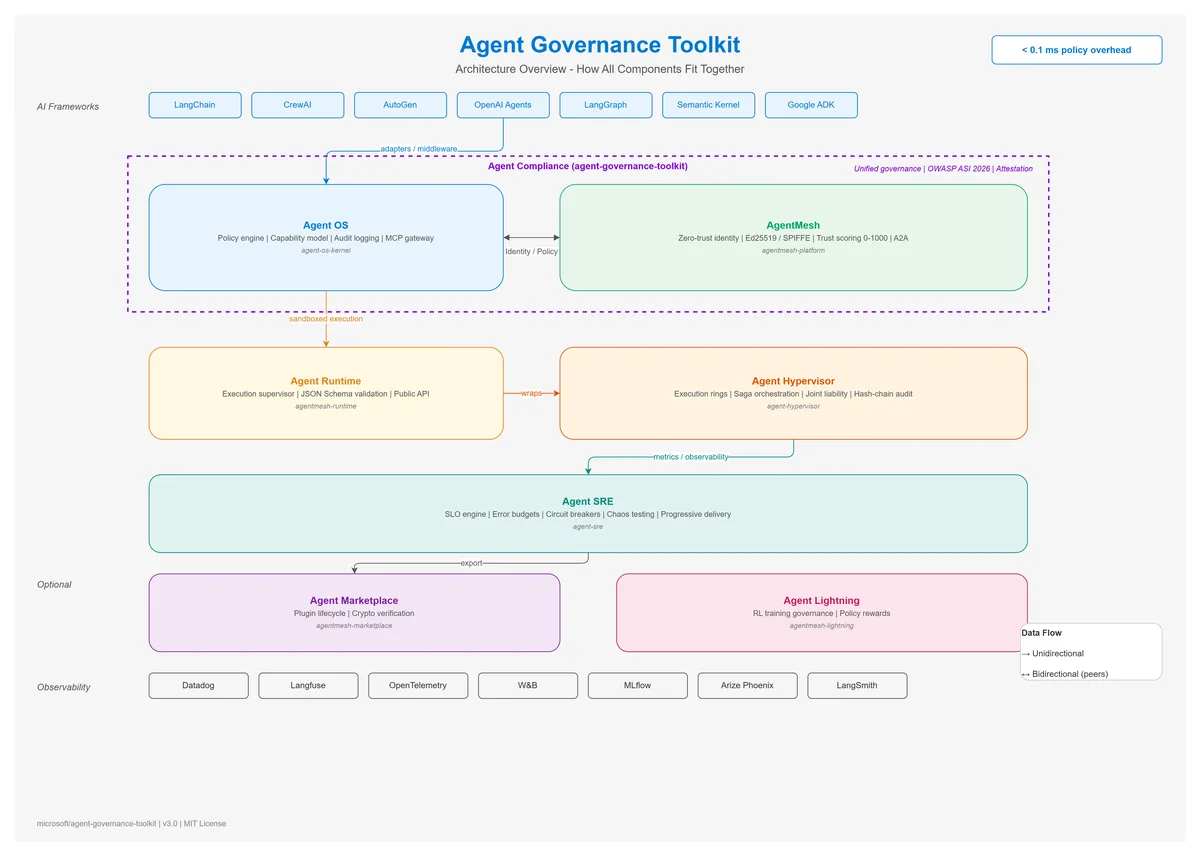
Agent Governance Toolkit, often shortened to AGT, is a modular governance stack for autonomous AI agents. It can intercept tool calls, messages, and agent-to-agent delegation in application code before an action reaches the outside world. Policies can then produce an enforceable decision and an audit record.
AGT is framework-friendly rather than tied to one agent runtime. The official integration list includes Microsoft Agent Framework, Semantic Kernel, AutoGen, LangGraph, LangChain, CrewAI, OpenAI Agents SDK, Google ADK, LlamaIndex, Haystack, Mastra, and Dify. SDKs cover Python, TypeScript, .NET, Rust, and Go, although Python currently exposes the broadest stack.
Main features
- Deterministic policy enforcement: evaluate YAML, OPA, or Cedar policies around tool actions instead of relying on a prompt to keep the agent in bounds.
- Agent identity and trust: AgentMesh provides identity, trust scoring, routing, and delegation controls for multi-agent systems.
- Sandboxed execution: Agent Runtime and Agent Hypervisor add privilege rings, execution-plan checks, command deny lists, and termination controls.
- Tamper-evident auditing: record what the agent requested, which policy was active, and why an action was allowed or denied.
- Reliability engineering: Agent SRE includes SLOs, error budgets, circuit breakers, kill switches, chaos testing, and progressive delivery tools.
- Compliance checks: the
agtCLI can verify evidence, lint policies, and run prompt-injection red-team scans. - MCP protection: the security gateway targets tool poisoning, hidden instructions, typosquatting, and unexpected tool drift.
What makes it different?
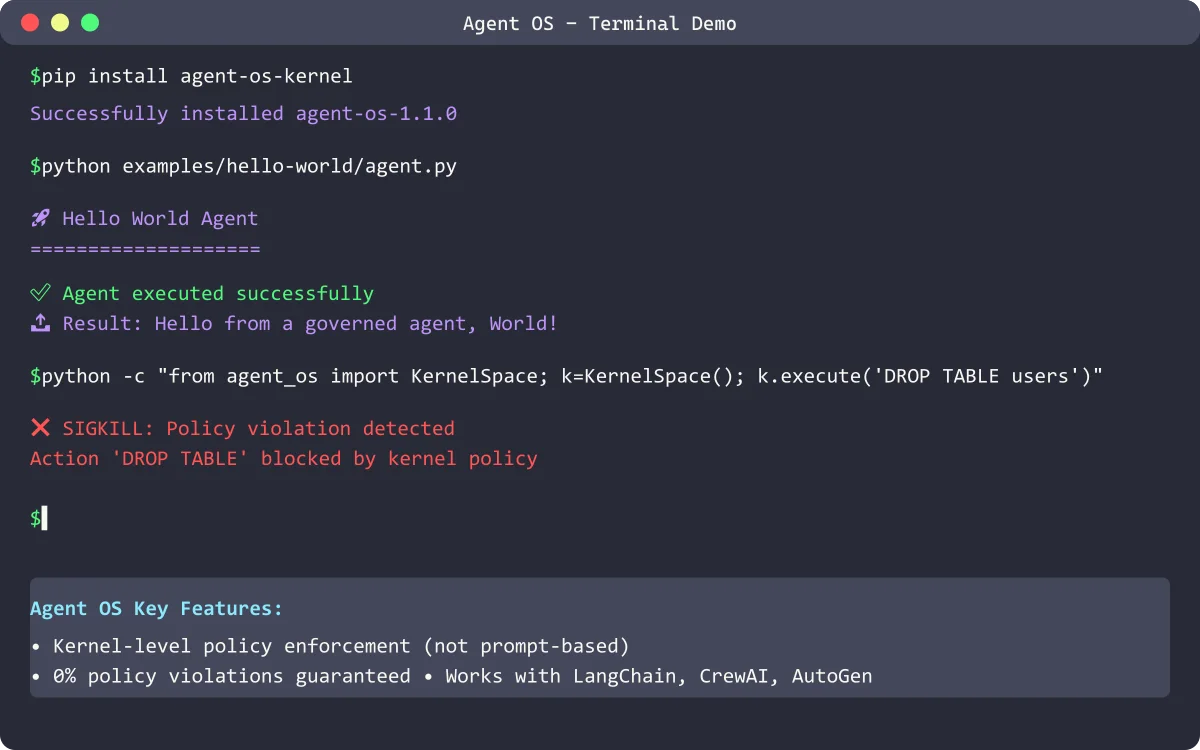
AGT focuses on the gap between model safety and application safety. A model can still be manipulated by prompt injection or make a bad decision during an otherwise normal conversation. When enforcement lives outside the model, a denied database operation remains denied even if the agent is completely convinced it should proceed.
The stack is also incremental. You do not need to deploy every component on day one. The maintainers recommend starting with a governed function and audit logging, then adding identity, trust, sandboxing, SRE, or fleet-level controls as the risk grows. That is much more realistic than asking a small team to adopt an entire governance platform before its first production agent.
How to install and use it
For Python, you need version 3.10 or newer. The full package gives you the modules used in the official quick start:
pip install agent-governance-toolkit[full]The shortest route is to wrap an existing tool function with govern() and point it at a YAML policy. Every call is checked and logged; a denied request raises GovernanceDenied before the original function executes.
from agentmesh.governance import govern

safe_tool = govern(my_tool, policy="policy.yaml")
Your policy can allow ordinary reads, deny destructive operations such as drop or truncate, and require a named approval group before sending email. Run agt doctor to check the installation, agt lint-policy policies/ to catch policy mistakes, and agt verify when you want an OWASP-oriented compliance check.
If your application is not Python-based, install the matching SDK instead: npm for TypeScript, NuGet for .NET, Cargo for Rust, or the Go module. Before production, test both allowed and denied paths, decide what happens when the policy service is unavailable, and keep approvals and audit logs outside the agent’s control.
Best use cases
Agent Governance Toolkit is most useful for agents that can change external state: customer-support agents sending messages, coding agents running shell commands, operations agents querying production systems, finance workflows moving data, or multi-agent systems sharing tools and credentials. It also fits regulated environments that need evidence of who requested an action and why it ran.
It is probably too much machinery for a private chatbot with no tools or sensitive data. The project is also still labeled a public preview, so breaking changes may arrive before general availability. Teams should pin versions, read the changelog, and treat upgrades like infrastructure changes rather than casual library updates.
Pricing and license
The project is free and open source under the MIT License. There is no required subscription for the toolkit itself. Real costs come from hosting policy and audit services, observability, secure identity infrastructure, storage, incident review, and the engineering work required to design policies that match your organization rather than merely looking comprehensive on paper.
My take
AGT solves a real problem with the right mental model. Prompts are useful guidance, but they are not access control. Putting an enforceable decision point between an agent and its tools gives developers something concrete to test, review, and audit. The wide framework and language support also makes the project easier to introduce without rebuilding an existing agent.
The caution is scope: this is a large, fast-moving toolkit, and governance quality still depends on the policies you write. I would start with one risky tool, define a small deny-and-approval policy, and verify the audit trail end to end. If that works cleanly, Agent Governance Toolkit can become a practical safety layer instead of another compliance dashboard nobody trusts.