
DeepSeek Harness
DeepSeek Harness is DeepSeek's experimental, MIT-licensed coding-agent runtime with replaceable plugins, inspectable sessions, multiple modes, and a local Web UI.
Quick verdict: DeepSeek Harness is an ambitious, plugin-based environment for building and running coding agents. It is unusually transparent about sessions, tools, context, and runtime composition, which makes it interesting to developers who want to inspect and reshape the agent loop instead of accepting a fixed assistant. It is also experimental developer-preview software, so it belongs in an isolated evaluation environment rather than an unreviewed production workflow.
What is DeepSeek Harness?
DeepSeek Harness, also called dsh, is an open-source agent harness developed by DeepSeek AI. A model supplies the reasoning, while the harness supplies the surrounding system that lets an agent inspect files, invoke tools, use skills, run commands, retain sessions, coordinate subagents, and work through longer tasks. The project provides a local Web UI and can be started from npm or built from its public source repository.
The project is not simply another chat interface. Its central idea is that nearly every agent capability should be replaceable: models, tools, storage, sessions, context handling, sandboxes, scheduling, user interfaces, and the agent loop itself are assembled as plugins. That makes DeepSeek Harness more relevant to agent developers and technically confident users than to someone looking for a polished, maintenance-free consumer chatbot.
An everything-is-a-plugin architecture
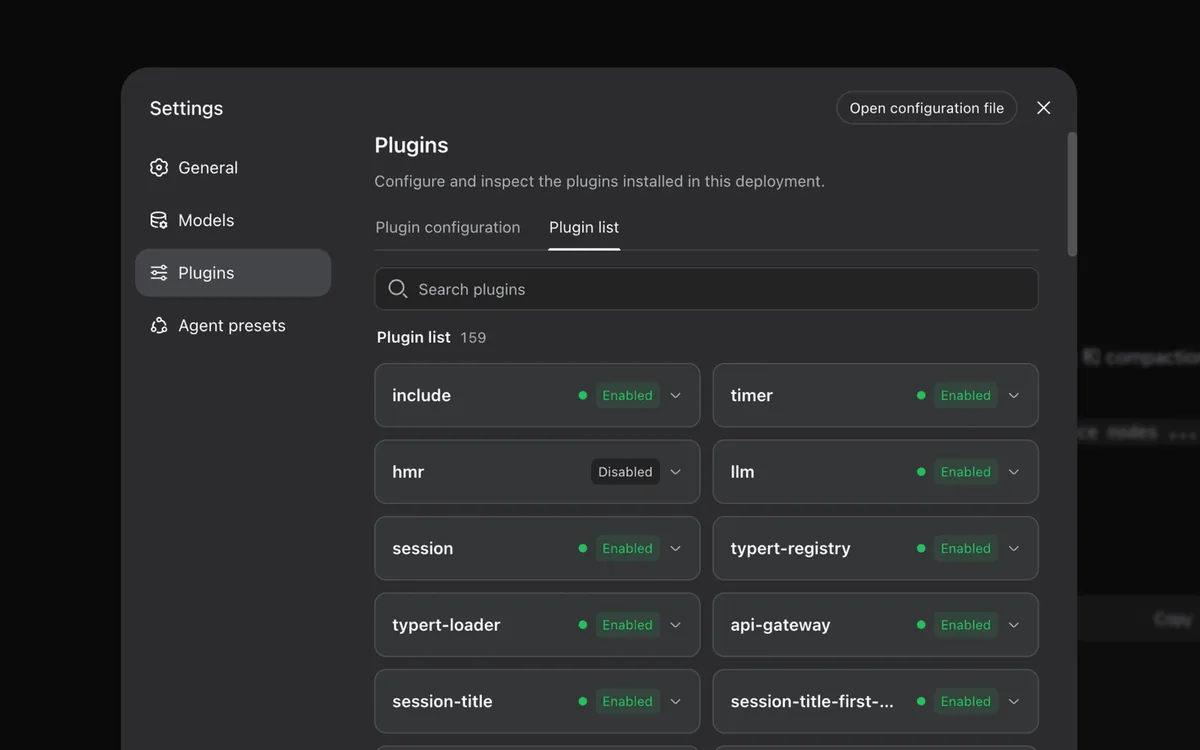
DeepSeek Harness is built on the Cordis plugin system. The kernel focuses on loading plugins, unloading them, and resolving their dependencies; agent behavior is supplied by services and events contributed by those plugins. According to the official project description, developers can select, replace, or extend capabilities through configuration instead of rewriting the core runtime.
This approach is valuable when a team wants to compare models, swap storage backends, add a specialized tool, or create a constrained agent preset. It also provides a path for community plugins through the dsh-plugin ecosystem. The flexibility comes with responsibility: every additional plugin expands the code and permissions that must be understood, updated, and trusted.
Inspectable sessions and multiple agent modes
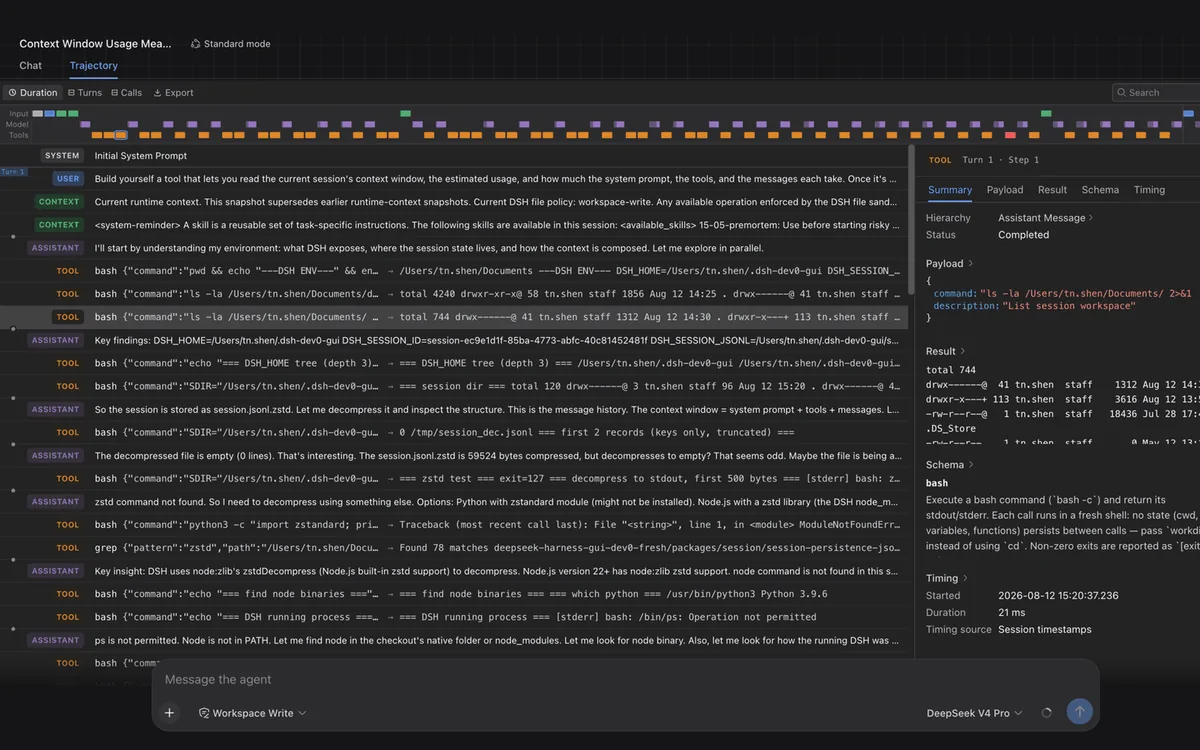
A notable feature is the append-only session event stream. The official site says that system prompts, context injection, tool calls and results, subagent scheduling, and other information shown to the model are recorded in the same session history. The Trajectory view can then organize that history by source, while resume, fork, search, and replay work from the same underlying event stream. This can make an agent run easier to investigate than a conventional chat transcript that hides most runtime activity.
DeepSeek Harness currently describes four modes. Standard mode provides the broad coding-agent toolset. Code mode exposes tools through a code-oriented SDK so the model can combine several operations in a TypeScript program. Minimal mode intentionally keeps only a persistent shell and a file-editing tool for constrained experiments. Creator mode adds runtime inspection and plugin experimentation for composing custom presets. These modes are useful design choices, but they are not security guarantees.
How to run DeepSeek Harness
The shortest official route requires Node.js and starts the local Web UI on http://127.0.0.1:3080 by default:
npx @deepseek-ai/dsh webDevelopers who want to inspect or modify the project can build the repository instead:
git clone https://github.com/deepseek-ai/deepseek-harness.git
cd deepseek-harness
pnpm install
pnpm run build
pnpm dsh web
The repository is moving quickly. The latest tag observed for this review is dsh-v0.1.5-alpha.1, released September 8, 2026, while the README explicitly warns that compatibility-breaking changes should be expected during the developer preview. The release notes also flag a session-format upgrade and plugin API changes. Pin the version or commit used for an evaluation, read the corresponding documentation, and avoid assuming that configuration or plugin APIs will remain stable across upgrades.
Privacy and data handling
DeepSeek describes the harness as local-first. Its data-processing statement says that prompts, model output, session context, tool-call records, attachments, file paths, results, logs, configured model endpoints, API keys, and personal information are stored and processed on the user’s device by default rather than uploaded without consent. That is a useful baseline, but it does not mean every possible workflow remains offline.
The same statement says the software may report desensitized configuration information and project lists for diagnostics and improvement, with options to disable reporting or change its destination. More importantly, model providers, network tools, MCP servers, and third-party plugins configured by the user may process or transmit data under their own policies. Before using a private repository, review the selected model endpoint, plugin set, telemetry configuration, and network permissions rather than relying on the word “local” alone.
Security limits you should understand
The project’s safety notice is direct: DeepSeek Harness has not undergone a security audit and must not be treated as secure or production-ready. It can execute model-generated code and commands, load third-party plugins, and access any network, process, credential, or file made available to it. Incorrect output, malicious input, software defects, configuration mistakes, or an untrusted plugin could modify or delete files, expose credentials, or damage the host system.
Sandboxing, permission controls, and approval prompts can reduce risk but cannot protect resources that the agent is already allowed to access. The maintainers recommend least privilege, backups, command and plugin review, and a disposable virtual machine, container, or dedicated environment. Those precautions are especially important when testing autonomous workflows or installing community extensions. DeepSeek Harness should never be the only security boundary around untrusted workloads.
Who is DeepSeek Harness for?
DeepSeek Harness is a strong evaluation candidate for developers studying agent runtimes, teams building custom coding workflows, and advanced users who want visible session trajectories and replaceable components. Its modes can support full-featured coding work, code-composed tool orchestration, minimal benchmark environments, and custom agent-preset development without forcing every use case into one fixed interface.
It is a poor fit for teams that need stable APIs, audited isolation, contractual support, or a production-ready platform today. Nontechnical users may also find the plugin model and operational responsibilities excessive. A good first evaluation is a small, disposable repository with no real credentials, limited network access, and a clearly defined task. Review the resulting file changes and Trajectory record before expanding its permissions.
Pricing, license, and final assessment
The DeepSeek Harness source code is released under the MIT License, and the repository also includes third-party notices for bundled dependencies. There is no license fee for downloading or modifying the open-source code. Actual usage costs depend on the model providers, compute, storage, and external services selected by the operator. A local interface does not make paid model APIs free, and plugins may introduce their own services or licensing terms.
DeepSeek Harness stands out because its modular architecture and detailed session record expose parts of the agent runtime that many products keep fixed or hidden. The rapid release activity makes it worth watching and testing. The same pace, alpha version, broad execution powers, and explicit lack of a security audit make caution essential. Treat it as a promising open agent laboratory, pin an exact version, isolate the environment, and promote it into real work only after your own workflow-specific review.