
OpenViking
OpenViking stores agent resources, memories, and skills in a browsable context filesystem with progressive loading and observable retrieval.
Quick verdict. OpenViking is a serious context database for teams that want agents to browse resources, memories, and skills through one visible structure. Its viking:// filesystem, progressive context layers, and observable retrieval paths make the system easier to inspect than a plain vector-search endpoint. The cost is operational weight. You still need models, storage, authentication, backups, and a careful upgrade routine.
The current stable release is v0.4.15, published on August 18, 2026. It fixes an especially important v0.4.14 dependency problem that could let a local VectorDB or cuVS write appear successful even though its vector was never stored. Anyone affected may need to rebuild those vectors. The main branch was already 20 commits ahead when this review was prepared, so production users should follow tagged releases and read migration notes instead of deploying the latest commit by habit.
What is OpenViking?
OpenViking is an open-source context database created by ByteDance’s Volcano Engine Viking team. It organizes external resources, user memories, agent experience, and skills under readable URIs. An agent can use familiar operations such as ls, tree, find, grep, and read while the service handles parsing, hierarchical retrieval, session commits, and memory extraction behind those commands.
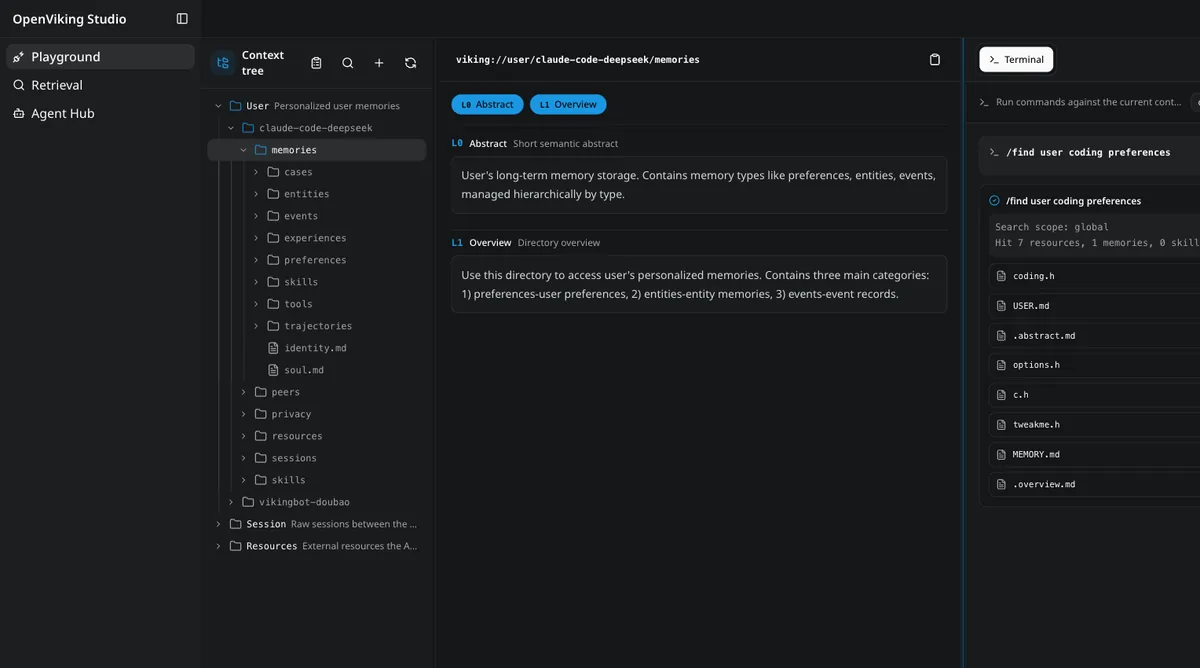
Each resource is processed into three depths. L0 is a short abstract for a quick relevance check, L1 is an overview for planning, and L2 holds the full detail. Directories also receive summaries, so retrieval can judge a branch before loading every file beneath it. The storage design separates full content from the vector index, and the retrieval layer records the path it followed. When a result looks wrong, the operator can inspect how the search reached it.
OpenViking Studio turns that structure into a browser interface. It exposes the context tree, resource details, retrieval tools, sessions, and agent-related areas. This is useful during setup because you can verify what was imported and whether L0 and L1 summaries match the underlying source before an agent starts relying on them.
Main features
- Unified context filesystem. Store resources, user memories, skills, peers, and sessions under consistent
viking://paths. - Progressive loading. Use L0, L1, and L2 layers to decide how much context a task needs before loading full documents.
- Hierarchical retrieval. Combine semantic search, directory traversal, intent analysis, keyword tools, and model reranking.
- Observable search. Preserve the retrieval trajectory so developers can debug which directories and results influenced a response.
- Session memory. Record messages and used context, then compress and commit sessions into longer-term memories and experience.
- Multiple interfaces. Connect through the bundled CLI, Python SDK, HTTP API, MCP, Web Studio, or documented agent integrations.
- Flexible deployment. Run the Python package locally, start the official Docker image, or operate a standalone server for shared clients.
- Operational controls. Add API-key identities, account and user boundaries, optional at-rest encryption, metrics, health checks, and backups.
What makes OpenViking useful?
The filesystem model gives an agent a stable map. A project document can live under resources, personal preferences can stay under one user, and learned procedures can become skills. That organization matters once a knowledge base grows beyond a few files. It also gives operators a concrete place to inspect, move, export, or delete context instead of treating every retrieved chunk as an anonymous database row.
The session pipeline is another practical strength. OpenViking tracks messages and the context an agent actually used, then commits selected history into memories. Supported integrations cover Claude Code, Codex, Cursor, OpenCode, OpenClaw, Hermes, TRAE, MCP clients, and LangChain or LangGraph. Integration depth varies, so check the individual guide before assuming that every client captures and commits the same events.
The official benchmark report is encouraging, with tests on LoCoMo memory questions and tau2-bench agent tasks. Those published figures use OpenViking v0.3.22, specific agents, models, and evaluation settings. They show that the project has a reproducible evaluation effort. They do not predict the accuracy, token savings, or latency of a different private knowledge base.
OpenViking remains early-stage and moves quickly. The optional VikingBot agent framework broadens the package, while the core identity remains context infrastructure. Teams should decide whether they need the bundled bot, the memory database alone, or a smaller retrieval service. Keeping that boundary clear makes upgrades and security review much easier.
How to install and get started
OpenViking requires Python 3.10 or newer and documents Linux, macOS, and Windows support. It also needs embedding and visual-language model capabilities for semantic processing. The setup wizard supports several hosted providers plus OpenAI-compatible endpoints, Codex OAuth, and local Ollama. Provider choice changes both cost and where imported content may travel, so make that decision before loading private files.
# Install or update the current stable package
pip install openviking --upgrade

# Create provider configuration and check it
openviking-server init
openviking-server doctor

# Start the local service on 127.0.0.1:1933
openviking-server

# In a second terminal, import and inspect one resource
ov status
ov add-resource https://github.com/volcengine/OpenViking --wait
ov tree viking://resources/volcengine -L 2
ov find "how does OpenViking load context"
Start with a disposable public repository. Confirm that processing finishes, inspect the generated abstracts and overviews in Studio, then compare a few retrieval results with the source files. This catches provider, parser, and indexing mistakes before sensitive material enters the system. Users coming from v0.4.14 should also check whether any missing recall traces back to the fixed xxhash issue and rebuild affected vectors.
Docker is convenient for a shared server, but its network behavior deserves attention. The official image binds to 0.0.0.0 inside the container and refuses to start without a root API key. Put public deployments behind HTTPS, restrict CORS, use user keys for normal access, and keep provider credentials out of images and logs. At-rest encryption is configurable with a local key, Vault, or Volcengine KMS. It does not remove the need to back up and protect the root key.
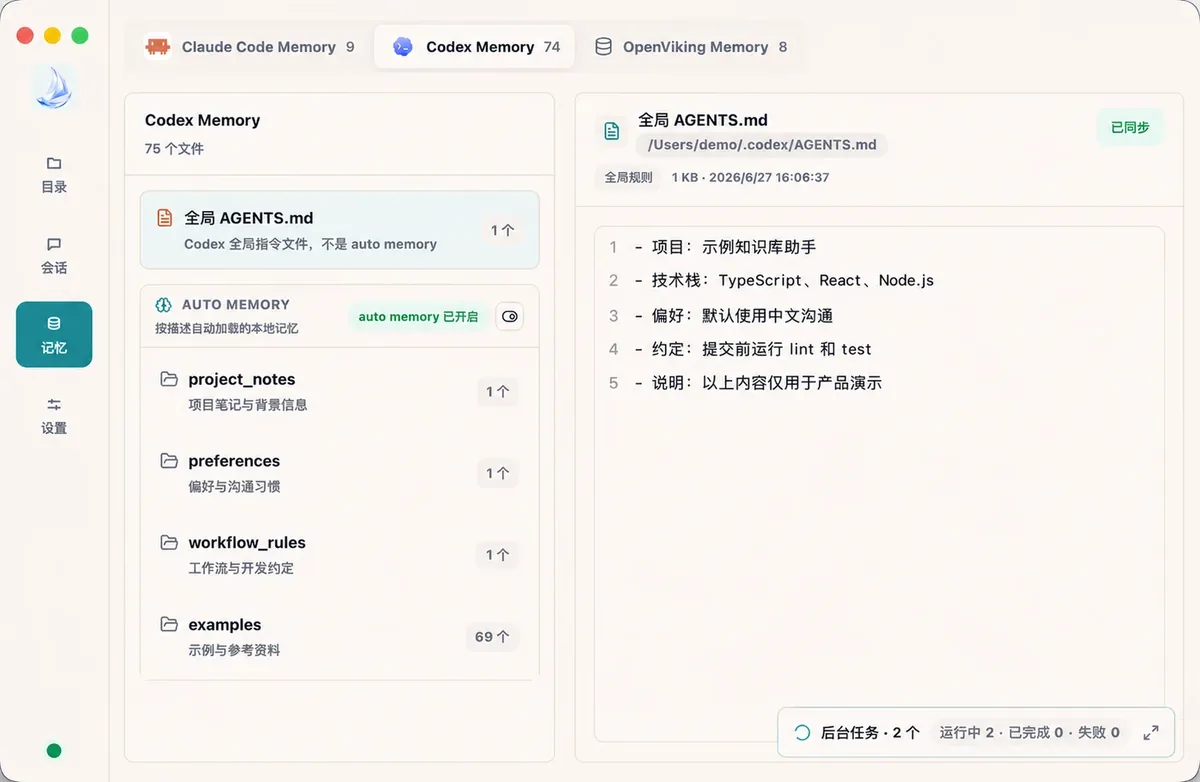
The separate OpenViking Helper offers visual setup, trace inspection, and local memory or skill management. It is currently beta and the README documents desktop downloads for macOS and Windows x64. Treat it as a convenience layer while keeping the server, CLI, and saved configuration understandable enough to recover without the desktop app.
Best use cases
OpenViking fits agent platforms that need one store for project documents, user memory, reusable skills, and session history. It can support coding assistants that carry context across tasks, internal research agents that must show retrieval paths, and multi-user services that need account-level resources alongside private user memories. The HTTP API and client libraries also make it useful when several applications need the same context service.
It is a heavier choice for a small static FAQ, a single short coding session, or a team that has no one to operate storage and models. A conventional search index may be simpler when memory extraction, skills, session commits, and progressive context layers bring little value. Highly regulated deployments also need an independent review of identity boundaries, provider data flows, encryption configuration, retention, and deletion.
Pricing and license
The main OpenViking project is available under the GNU AGPL v3. The repository assigns Apache 2.0 to crates/ov_cli and the examples, while third-party components keep their original licenses. AGPL obligations matter when you modify covered server code and make it available over a network, so organizations should review their deployment and distribution plans with appropriate counsel.
The open-source edition has no feature gates, account requirement, activation key, or product subscription according to the official README. Your real bill can include model and embedding APIs, compute, storage, backups, monitoring, and engineering time. Local Ollama can reduce provider exposure, though it moves the cost to hardware and maintenance. Volcano Engine also offers managed SaaS and licensed self-managed commercial editions. The public project material does not provide a complete price table, so request a current quote for those options.
My take
Based on the current documentation and release history, OpenViking has a thoughtful answer to a real agent problem. Context becomes easier to inspect when it has paths, layers, and a visible retrieval trace. The project also acknowledges production concerns such as tenant identity, API keys, encryption, readiness checks, and index repair. That is more useful than a memory demo that stops at vector search.
I would introduce it gradually. Pin v0.4.15, connect one model provider, import non-sensitive material, and measure retrieval quality against known questions. Test backup and restore, then add one agent integration and watch what each session commits. OpenViking can become valuable shared infrastructure when a team is ready to own those checks. Without that ownership, its fast release pace and broad feature set can create a second system that is difficult to trust.