
Wren AI
Wren AI is an open-source ai data platform for analysts and engineering teams that want natural-language access to databases and business data, with public code and self-managed setup options.
Quick verdict: Wren AI is an open-source ai data platform aimed at analysts and engineering teams that want natural-language access to databases and business data. It is worth a look if you want inspectable code, flexible deployment, and fewer limits than a closed hosted product. The trade-off is that installation, model access, updates, and production reliability remain partly your responsibility.
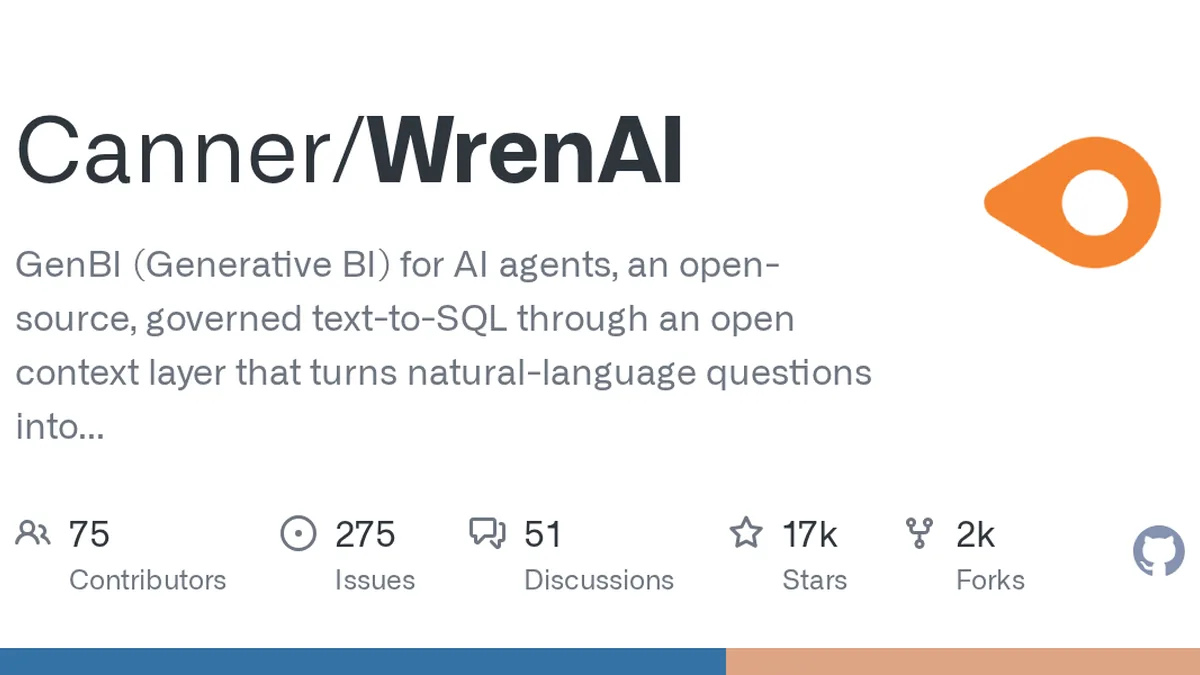
GenBI (Generative BI) for AI agents, an open-source, governed text-to-SQL through an open context layer that turns natural-language questions into trusted dashboards, charts, and SQL across 20+ dat…
What is Wren AI?
Wren AI is developed in public on GitHub, where you can review the source, documentation, open issues, and release history before adopting it. That matters for an AI tool: capabilities change quickly, integrations break, and the repository is usually a more reliable source than an old third-party tutorial.
The project sits in the Data & Analytics category. In practical terms, it is designed for text-to-SQL, database exploration, business intelligence, analytics copilots, data agents, and internal reporting. It can be useful as a ready-made tool, a development foundation, or a reference implementation, depending on how much infrastructure and customization you want to own.
Main features
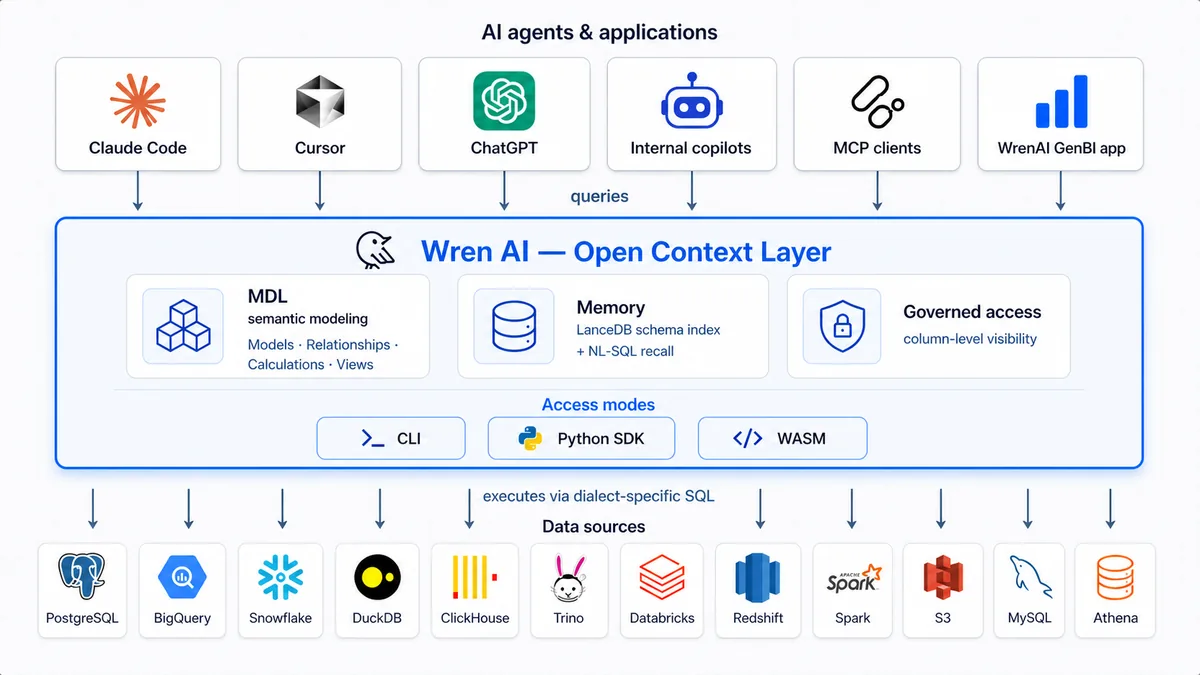
- Sits on top of your existing stack. Warehouse, transformation pipelines, your existing semantic layer. Not another tool to maintain.
- Correctness as primitives. Rich schema retrieval, dry-plan validation, structured errors with hints, value profiling, eval runner. The agent orchestrates; the trace lives in its reasoning.
- Knowledge management built in. Business meaning, approved definitions, and proven examples are captured as reviewable, version-controlled context, not buried in prompts.
- Generative BI, end to end. Not just text-to-SQL. Generate the answer, deploy the dashboard, share the URL, all driven by the agents you already use.
- User asks their agent (in plain language) for a dashboard
- Agent writes governed SQL via the Wren context layer, builds the app
- wren genbi deploy produces a live, shareable dashboard URL
- Generate. Your agent turns a business question into governed SQL and charts. Schema-aware retrieval, MDL planning, dry-plan validation, and structured errors keep it correct instead of confidently wrong.
Feature lists on fast-moving repositories can change between releases, so treat the items above as a snapshot rather than a permanent contract. Before choosing the tool for a critical workflow, check the current README, configuration reference, and issue tracker for the exact providers, models, operating systems, and deployment modes supported by the version you plan to install.
What makes Wren AI useful?
The main appeal is control. You can inspect how the project works, adapt it to your environment, and decide where data, prompts, generated files, and credentials are stored. That is a meaningful advantage for teams that have privacy requirements or want to avoid building an important workflow around a single hosted interface.
Open source does not automatically mean effortless, though. Natural-language analytics still requires permissions, schema context, query review, and safeguards against expensive or misleading results. Documentation quality, backward compatibility, and community support can also vary from one release to the next. I would test the smallest useful workflow first, measure the result, and only then add more models, integrations, users, or infrastructure.
How to install and get started
Use the official quick start rather than copying an installation command from an unrelated blog post. Confirm the supported runtime, operating system, memory requirements, model credentials, and storage needs first. A virtual environment or container makes experiments easier to remove and reduces dependency conflicts with other AI projects.
pip install wrenai                      # core (DuckDB included)
pip install "wrenai[postgres,memory]"   # add per-datasource and memory extras as needed
After installation, run the smallest included example and keep it local until you understand the default network bindings and authentication behavior. Do not expose a development server directly to the public internet. If the project connects to commercial model providers, store API keys in environment variables or a secret manager rather than committing them to configuration files.
Best use cases
Wren AI is most interesting for text-to-SQL, database exploration, business intelligence, analytics copilots, data agents, and internal reporting. Individual users can run a private experiment without waiting for a vendor roadmap, while development teams can integrate the underlying components into a larger product or internal platform.
It is a weaker fit when you need a fully managed service, contractual support, guaranteed uptime, or a nontechnical onboarding experience. In that situation, a hosted product built on similar technology may cost more but save considerable operational time. The right choice depends less on the word “open source” and more on who will maintain the system after the first successful demo.
Pricing and license
The Wren AI source repository is available under the Apache-2.0 license. There is no subscription fee for downloading the code itself. Real costs may include compute, GPUs, storage, hosted databases, model API usage, bandwidth, monitoring, and the engineering time required to deploy and update it. Review the license and any separately licensed model weights before commercial use.
My take
Wren AI is a sensible option for technically comfortable users who value transparency and control. Its public repository makes it possible to verify the current state of the project instead of relying on marketing claims, and the surrounding examples can shorten the path from an idea to a working prototype.
I would still treat the first installation as an evaluation, not an immediate production commitment. Test the exact workflow you care about, check recent maintenance activity, read open issues related to your platform, and confirm that the license and model dependencies fit your use case. If those checks look good, Wren AI can be a practical foundation rather than just another interesting GitHub bookmark.